What to See Inside the Descalzas Reales
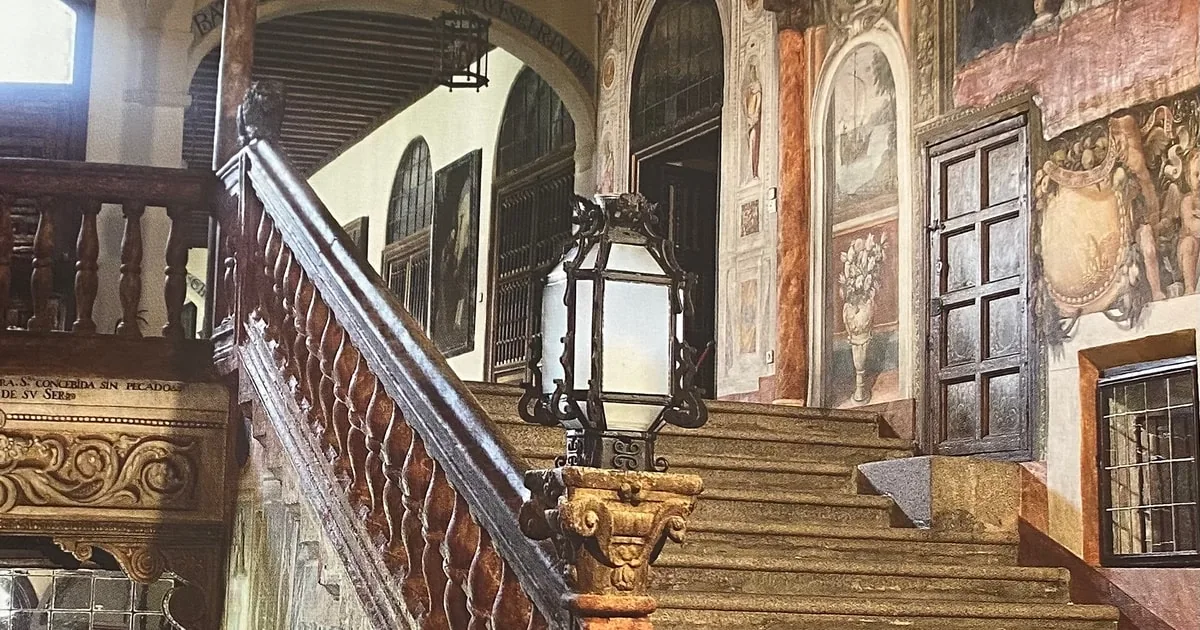
The staircase: the moment the visit turns
You enter through an unmarked door on Plaza de las Descalzas. The lobby is plain brick, narrow, institutional. Then the guide opens the second door and you climb the grand staircase, and the entire ceiling is covered in frescoes. The painter Antonio Rizi painted the glorification of Saint Clare in the vault — clouds, light, angels, the saint ascending. It is the moment the visit shifts from "this is a working convent" to "this is a palace." The architectural move is deliberate. The outside facade stays plain so the building does not advertise itself. The inside stairs are the reveal. Every visitor stops. Every guide lets you look up for a moment before herding you onward.
The Rubens tapestries: the single most valuable thing
In a room off the upper cloister hang the tapestries of the Triumph of the Eucharist, woven in silk, wool and silver thread from cartoons by Peter Paul Rubens. They were commissioned by the Infanta Isabel Clara Eugenia. This set is one of the most valuable textile collections in Spain. The guide will walk you through them quickly — they are old and fragile and light-sensitive, so they do not get much wall time. But if you know to look closely, you will see the detail: the silver thread catches the light, the faces are specific, the composition is wild. They are what royal patronage looked like at its most confident.
The relicario: silver, holiness and superstition
The relicario is a room of reliquaries — small objects that contain pieces of saints or pieces of cloth said to have touched saints. Queens including Isabel de Valois and María de Austria gave these to the convent. Many were made by Flemish silversmiths. They are small, intricate, and very strange to modern eyes. A reliquary might be a silver box the size of a hand, with a crystal window so you can see a tiny scrap of cloth inside, and prayers engraved on the back. The relicario room collects hundreds of these objects. The guide will rush you through. The room is small, the reliquaries are dense, and there are other groups coming. But this is the room where European royal devotion gets material and specific. Read more on what else to see nearby if you want the larger history of Flemish art in Spain.
The paintings: Titian, Brueghel, Giordano
The Descalzas holds paintings by Titian (Venetian, sixteenth century), Pieter Brueghel the Younger (Flemish), Bernardino Luini (Italian), Juan Sánchez Coello (Spanish court painter), and Luca Giordano (Neapolitan, seventeenth century). The guide will point some out; some you will miss if you are not looking. This is not the Prado — the monastery has perhaps a few dozen paintings, not thousands — but the quality is high. If you are an art historian, you will want to spend an hour here. If you are a casual visitor, you will spend forty minutes and feel like you have seen something real.
The Capilla del Milagro and the upper cloister chapels
The Capilla del Milagro (the Chapel of the Miracle) is frescoed. The upper cloister has a series of smaller chapels, each one endowed by a different noble family. The guide will walk you through them in order. Each has a different altar, a different paint job, a different patron saint. Most visitors get tired by this point in the tour and stop paying attention. The guide knows this; they move faster. But if you have been reading about the families beforehand, or if you care about what sixteenth-century Spanish piety looked like in a convent setting, this is where that story lives.
Bring reading glasses if you use them. The reliquaries are small, the paintings have small detail work, and the rooms are lit at the level of a working convent (good enough to live in, not bright enough for a museum). A phone flashlight helps.
What you will walk past quickly
There are parts of the visit the guide will hurry you through: the cloister proper is closed to visitors, so you see it from windows. The nuns' own chapel is not open. Many doorways are roped off. The convent is not a museum; it is a working enclosed convent where a community of Poor Clare nuns actually lives. The parts you see are the parts that have always been semipublic — the royal apartments, the staircase, the rooms where royal guests stayed. The rest of the convent is theirs, and you do not get to see it.
Frequently asked questions
What are the must-see artworks at the Descalzas Reales?
The staircase fresco by Antonio Rizi, the Rubens tapestries of the Triumph of the Eucharist, the relicario (reliquary room) full of Flemish silverwork, and paintings by Titian, Brueghel and Luca Giordano. But the guide rushes through all of them, so an English-language guided tour (from €39) or foreknowledge helps.
Are there artworks by famous painters?
Yes. Titian, Brueghel, Giordano, and Sánchez Coello (the Spanish court painter). But this is not the Prado — there are perhaps a few dozen paintings in the whole convent, not thousands. The quality is high but the quantity is small.
How much time should you spend inside?
The guided visit takes 60–90 minutes, and that is the whole experience. It is not a place you wander for hours. Most visitors are done in about an hour.